
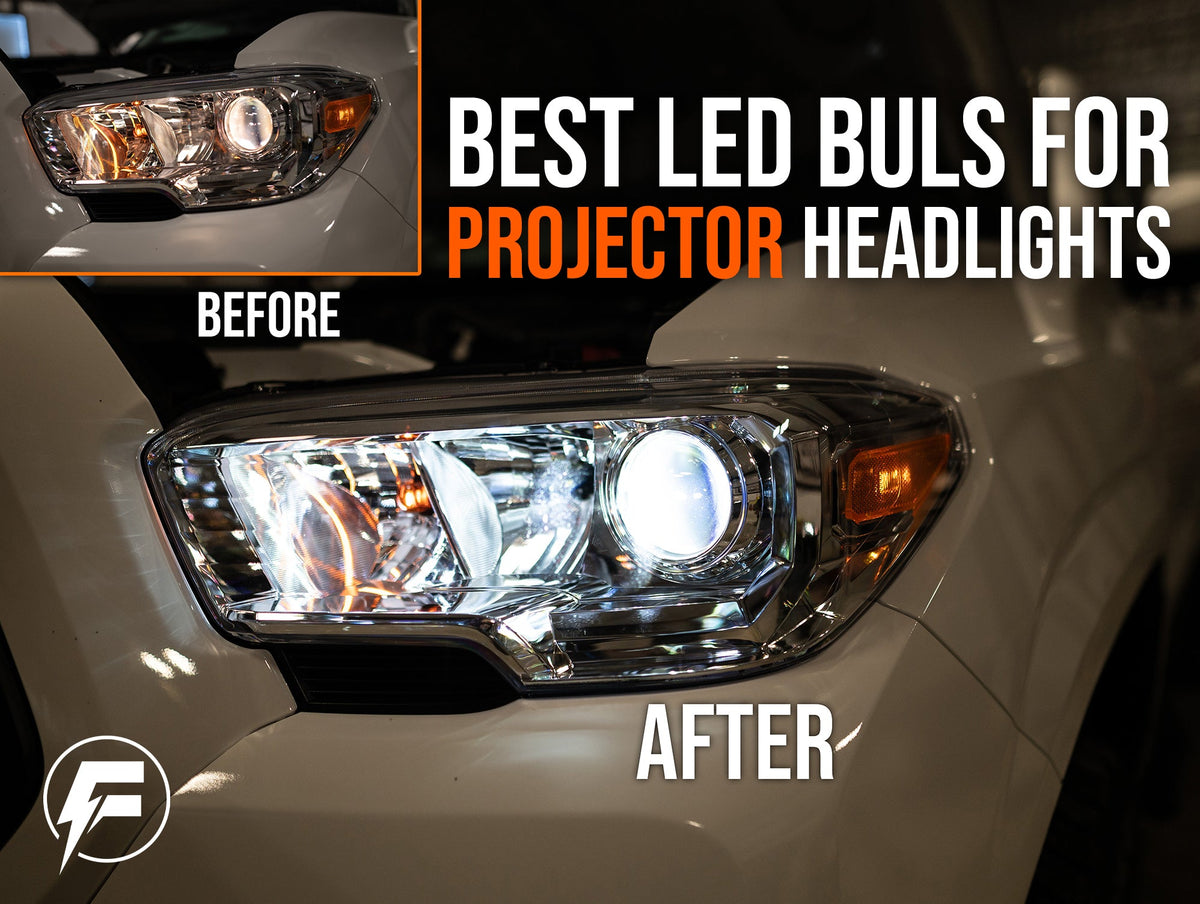
What makes an LED bulb a good choice for projector headlights? It's not just how many lumens are printed on the box. The position, size, and orientation of the light source determine how a projector collects that light and shapes it into a usable beam.
We designed our standard FUZED F1 Series around the location of the original halogen filament. Below, we'll show the physical design, explain how the adjustable base works, and share photographs from actual F1 Series installations. These examples show what we've observed—not a promise that every headlight assembly will perform identically.
Why F1 Series LED chip placement matters in projector headlights
A halogen projector is engineered to work with a light source in a particular location. An LED replacement can be bright but still create a poor pattern if its emitting surfaces are displaced from where the filament originally sat. That's why we focus on light-source geometry before raw output claims.
The standard F1 Series uses 6mm-tall LED chips, compared with a halogen filament approximately 5mm tall in our comparison. The emitting area has the same width as the reference filament. The LED chips are positioned to match the filament location in all three dimensions relative to the bulb's mounting geometry.
Our 1.6mm-thick circuit board keeps the two LED emitting surfaces close together. The intent is to preserve the light-source position that the original headlight optics were designed around, rather than moving the light source farther apart on a thick mounting board.

Real-world F1 Series projector headlight results
Rather than claim a universal brightness increase, we prefer to show the pattern produced in actual installations. Camera exposure, distance, and ambient lighting can affect how bright a photograph appears, so these images are visual examples rather than controlled lux measurements.
Toyota Tacoma: standard F1 Series in factory projector headlights
Our 2016–2023 Toyota Tacoma projector installation is a confirmed standard F1 Series application. It is one of our primary examples because we have photographed the halogen and LED beam patterns on the same vehicle.

In this application, we observed a more defined-looking cutoff, a stronger-looking central hotspot, and a wider illuminated area after the F1 upgrade. These are observations from the installation, not measured claims for all Tacoma projectors.
Chevrolet Silverado: halogen and F1 Series projector comparison
These photographs show a 2014–2018 Silverado projector-headlight application before and after upgrading to the standard F1 Series.


Nissan Rogue Sport: installed appearance before and after
These photos are from a 2020 Nissan Rogue Sport, using the standard F1 Series.


2018 Toyota 4Runner: F1 Series H11 output on a dark road
This road photo shows the standard F1 Series H11 bulbs in the factory halogen projector headlights of a 2018 Toyota 4Runner. It provides a real-world view of the light distribution beyond a garage-wall test.

Additional projector beam comparison


Ram projector: F1 Series bulb installed in the housing
This Ram photo is included specifically to show a current standard F1 Series bulb installed in a projector housing.

An adjustable base makes proper LED orientation easier
Correct light-source position is only part of the equation. The LED emitting surfaces also need to face the intended direction within the housing. If a bulb is clocked incorrectly, the projected beam can change even when the bulb fits the socket.
The standard F1 Series has a rotationally adjustable mounting base. Instead of loosening and tightening a small set screw, you can adjust its orientation by turning the base. This simplifies fine-tuning during installation.
After installation, inspect the beam on a level surface and compare it with the original pattern. Make sure the cutoff is appropriately positioned and the headlights are aimed correctly. Rotating a bulb is not a substitute for aiming the complete headlight assembly, and neither adjustment can correct fundamentally incompatible optics.

F1 Series vs. F1 Plus vs. F1 Mini: which should you choose?
For most supported applications, our standard F1 Series is the starting point because its light-source positioning and easy rotational adjustment are the features documented in this guide.
| Series | How to think about it |
|---|---|
| F1 Series | Our go-to option for many compatible applications; the 6mm chip and 1.6mm board details in this article refer specifically to this series. |
| F1 Plus | A higher-output option for applications where its fitment and electrical requirements are appropriate. Don't assume more output automatically creates a better projector beam. |
| F1 Mini | A compact alternative where space and fitment are priorities. Its geometry and performance should be evaluated separately from the standard F1 Series. |
Before you buy: check bulb size and headlight type
Not every projector uses a replaceable halogen bulb. Some use HID lamps or integrated LED modules, and the correct bulb size can vary by model year and trim. Confirm the original headlight system and bulb size before ordering.
Shop LED Headlight Bulbs for Your Projector Headlights
Choosing the correct LED bulb starts with identifying your vehicle's factory headlight type and bulb size. Browse our LED headlight bulb collections below to find the right upgrade for your projector headlights.
Have Factory HID Projector Headlights?
Factory HID projector headlights require a different upgrade solution than halogen projector headlights. FUZED LED offers HID-to-LED conversion options for supported vehicles.
- D3 HID-to-LED Plug-and-Play Conversion Kit
- D1 / D2 / D3 / D4 HID-to-LED Ballast-Bypass Conversion Kit
Important: Always verify your vehicle's factory bulb size and headlight configuration before ordering. Halogen-replacement LED bulbs and HID-to-LED conversion kits are not interchangeable.
Projector LED bulb FAQs
Why does LED chip position matter in a projector?
A projector collects light from a specific region inside the housing. Moving the light source can change the cutoff, hotspot, and distribution even if the bulb is very bright.
Does a brighter LED bulb always work better in a projector?
No. Usable light distribution, bulb orientation, and compatibility with the projector optics matter alongside output.
What is different about the standard F1 Series base?
Its mounting base can be rotated for emitter alignment without loosening a set screw, simplifying adjustment during installation.
Will F1 Series bulbs give every projector the same cutoff?
No. The F1 Series is designed around factory filament positioning, but the final pattern depends on the specific housing, correct fitment, orientation, and headlight aim.
Are the F1 Series chip dimensions the same as F1 Plus or F1 Mini?
The 6mm chip height and 1.6mm circuit-board thickness discussed here are specifications of the standard F1 Series. They should not be assumed for the other series.